CONTACT
Email: contact.ericahart@gmail.com
Instagram: @erica_hart
BIO
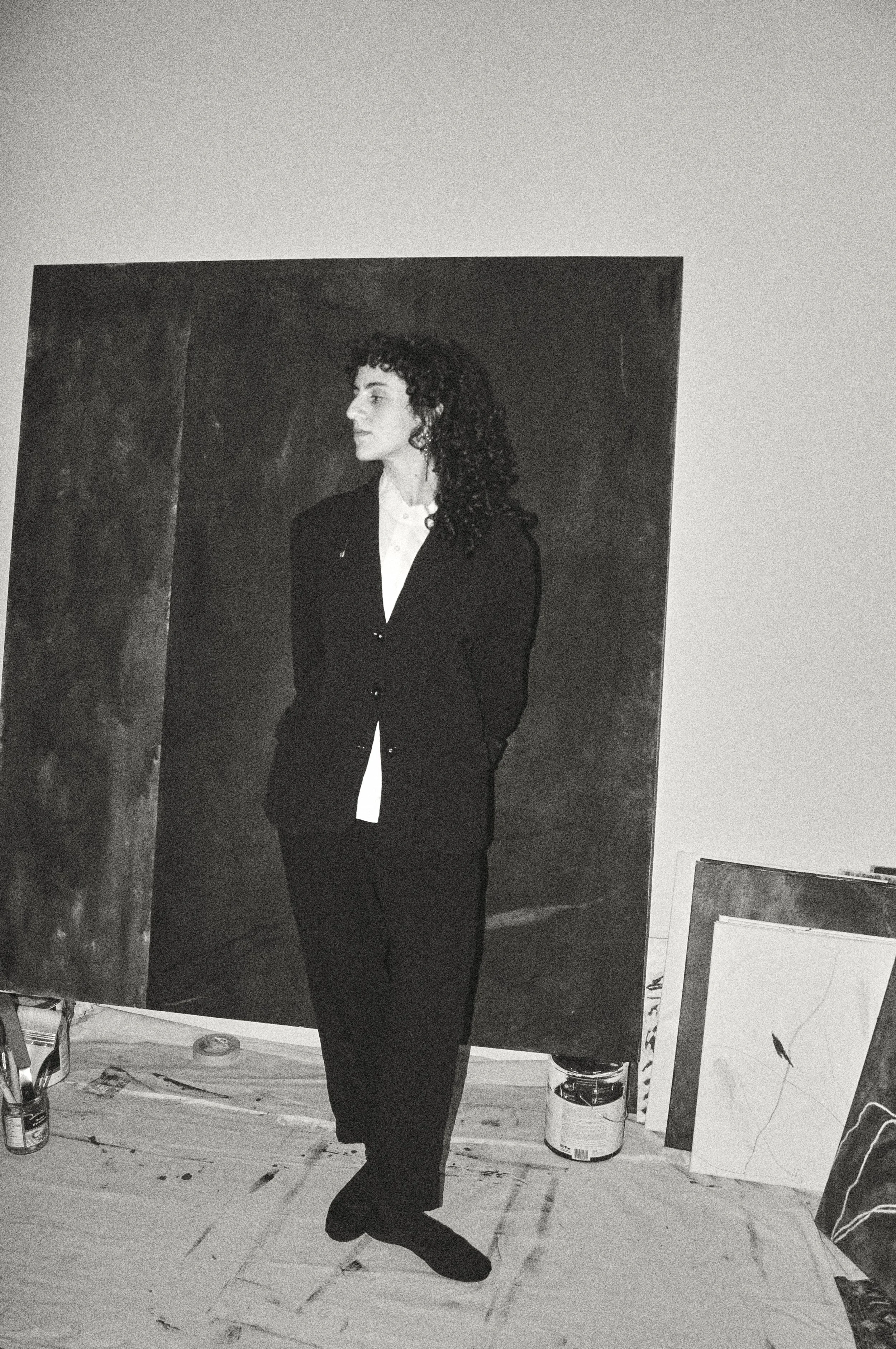
Erica Hart is a queer artist from Tkaronto (Toronto), based in Tiohtià/Mooniyang (Montréal), working primarily in drawing, painting, and performance. Their practice examines attention, embodiment, and the subtle ways bodies and environments shape one another through everyday experience.
Rooted in archival studies and somatic approaches, Hart’s work considers drawing as a form of record-keeping—not of events or facts, but of fleeting experiences that often disappear before they are remembered. Through abstract mark-making, environmental sampling, and processes of layering, accumulation, carving, and erasure, Hart translates movement, sensation, sound, and observation into visual forms that invite slower ways of looking.
Hart holds a Bachelor of Fine Arts from Concordia University and a Master of Information Studies from McGill University, where they focused on archival research and preservation. Their archival work has included visual and cultural collections at Concordia University, including the Canadian Women Artists History Initiative (CWAHI) and the Digital Image & Slide Collection (DISC), as well as zine archiving with QPRIG McGill. They have also pursued independent studies in somatic and body-based approaches to perception and movement.
Hart’s work has been exhibited at Art Mûr, Studio XX, White Wall Studio, and Twist Gallery, and published in Artist Drawing Magazine UK, The Pit Magazine, and Section 1 Magazine. From 2017 to 2019, Hart co-founded Somewhere Shared, a studio-led artist collective focused on collaborative exhibitions in non-traditional spaces. They have facilitated drawing and movement-based workshops at Moving Just Fine, Studio 414, and Circuit-Est, extending their interest in observation and embodiment into collective practices.
ARTIST STATEMENT
I'm interested in moments that usually disappear before we think to remember them. My attention moves between people, architecture, movement, and the surrounding environment, settling on details that might otherwise go unnoticed. These experiences are fleeting, yet they shape how we move through and understand the world.
I have come to think of drawing as a way of paying attention rather than making pictures. It allows me to slow down and observe how people move through space, how environments shape the body, and how everyday experiences leave traces. My background in archival studies has shaped this way of working. Through studying archives, I became interested in how decisions about what to preserve shape the ways we understand and remember the past. I also became interested in the challenges of documenting the ephemeral and began wondering if drawing could become another kind of archive, one that gives form to fleeting experiences that might otherwise go unrecorded.
My process begins with environmental sampling, gathering impressions through movement, sensation, listening, and attentive looking. Quick drawings become abstract field notes that record gestures, rhythms, and textures rather than fixed images. In the studio, these observations are translated through painting, layering, carving, accumulation, erasure, and found materials. Each stage becomes an act of translation, allowing experience to shift from body to drawing, drawing to painting, and memory to material.
I'm interested in the quiet significance of experiences that often pass unnoticed. Through my work, I hope to encourage a slower kind of looking and greater awareness of our bodies and the environments we inhabit.